
India is back on the diplomatic table pushing oil producing countries to raise production in a bid to cool down runaway oil prices. Brent crude oil prices traded above $90 a barrel, on Thursday, for the first time since 2014. Brent is the most popular marker for crude oil trade. It is used as a benchmark for two-thirds of the world's internationally traded crude oil.

The kingdom, the world's leading oil producer, also offered to coordinate with the Organisation of Petroleum Exporting Countries and other major producers to ensure adequate fuel supply in order to curb prices. Pressure is being mounted on OPEC, the supplier of more than a third of the world's oil, to boost output in order to ease the effect of high prices on economies across the world.
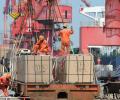
Imports too declined 26 per cent to $29.47 billion in August, leaving a trade deficit of $6.77 billion.
Growing for the third consecutive month, the country's exports rose marginally by 0.67 per cent year-on-year to $27.93 billion in February even as trade deficit widened to $12.62 billion, according to official data released on Monday.

The trade deficit marginally narrowed to $12.5 billion last month from $12.8 billion in July.
OPEC expects an additional daily average output growth of 1.2 million barrels or a daily average oil output of 87 million barrels in 2008. The OPEC output quota this year will be less than 32 million bpd and non-OPEC output would be about 50.3 million bpd, according to a report . OPEC's actual production will be higher than the quota but that will not be sufficient to coverup the demand-supply imbalance in the international market.
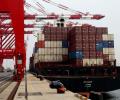
Imports too declined by 16.31 per cent to $37.39 billion.

Sectors with positive growth during the month include rice, iron ore, oil seeds, oil meals, meat, dairy and poultry products, pharmaceuticals, coffee, engineering goods, and plastic.

Out of 30 key export sectors, as many as 22 showed negative growth in September.
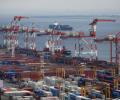
Barring rice, spices, iron ore and pharmaceuticals, all the remaining 26 key sectors registered negative growth in May. Imports too plunged 51 per cent to $22.2 billion in May.

Removal of this status means India can now enhance customs duties to any level on goods coming from Pakistan.
A combination of externalities such as global trade wars and slowing growth, continuing glitches in accessing offsets under the GST regime, which has created a liquidity crunch for smaller exporters, and the growing competitiveness of smaller countries are causing the slowdown.
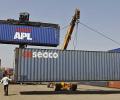
With exporters' claim for over five months still pending, liquidity has been wiped out and the process of finalising new contracts has been held up.

The declining exports would have implications for the job market.

Crude oil has fallen about 40 per cent since mid June and the price on Monday touched its lowest level since mid 2009 before US oil prices posted their biggest one-day gain in two years overnight.

Indian companies place orders worth $600 million for US crude, which is likely to increase by nearly $2 billion in the near future.
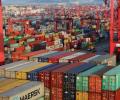
Imports too tumbled by 58.65 per cent to $17.12 billion in April from $41.4 billion in the same month last year, according to the data by the commerce and industry ministry.
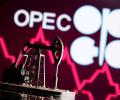
Changes in global oil and gas rates matter more to India's economy than other major economies because the country imports around 87 per cent of its oil, half of its gas in the form of LNG, and over 60 per cent of its LPG.

Some of these nations are India's biggest export market. India is also dependent on these countries to meet its energy needs.
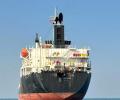
'If attacks escalate, there is a risk the Suez Canal may be closed.'

Various global and domestic factors had a sizable impact on the performance of the Indian markets

The country's current account deficit is likely to hit a three-year high of 1.8 per cent or $43.81 billion in FY22, as against a surplus of 0.9 per cent or $23.91 billion in FY21, a report said on Thursday. According to an assessment by India Ratings, the Current Account Deficit (CAD) has moderated to $17.3 billion or 1.96 per cent of GDP in the fourth quarter of FY22 as against $8.2 billion or 1.03 per cent in the year-ago period, and massively down from $23.02 billion or 2.74 per cent in Q3, which was a 13-quarter high. The improvement in the key numbers are due to the remarkable improvement in merchandise exports in FY22, when it grew 42.4 per cent as against a negative 7.5 per cent in the pandemic-hit FY121.

What stood out in his 15-year journey as a member of the political executive at the Centre was his glowing record as India's most successful and effective finance minister. Both as prime minister and finance minister, he understood the importance of gradualism, except when the economy or the polity was in a crisis.
Imports increased by 4.5 per cent, the highest growth in the last six months as crude oil and gold shipments shot up in the month.
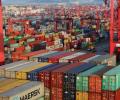
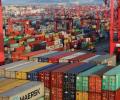
India's exports dipped after a gap of four months in March but finished 2017-18 with a healthy rise of 9.78 per cent to $302.84 billion.

Saudis are interested in expanding their relationship with India, given it is becoming the main driver of crude demand growth in Asia
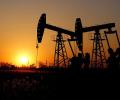
'The impact of COVID-19 on the economy has been so overwhelming that even a significant drop in global oil prices, which in normal times would have brought cheer, has posed new challenges for the government,' observes A K Bhattacharya.

India's exports are estimated to have remained at around $312 billion in 2013, while the final figures for 2014 could be around this figure only.
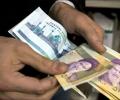
Economists polled in a recent survey by Ficci unanimously felt that the rupee will continue to be under pressure in 2018-19
.jpg)
The 30 Sensex companies alone, which are among the biggest companies in the country, now account for nearly 50% or about Rs 47 lakh crore of total investor wealth.

World trade has been growing slower than world GDP since 2012.

Falling sales since demonetisation has alarmed CEOs, who want to save cash till the economy recovers.

Most of India's oil supplies are expected to stay safe because of the country's good relations with both Russia and Iran. That would take care of over a third of India's supplies.
Two projects in Iran, which India is to execute involving major financial commitments on its part, are of particular significance for Indian steel.

'2019 was fought on delivery. But in 2024, you can see the before and after effects.'

Banks and companies in India are taking a cautious approach towards Sri Lanka, which, reeling from a financial crisis, has sought a $1-billion loan from the country to import essential commodities. A senior State Bank of India (SBI) executive said the bank was committed (to Sri Lanka) for the long term. "As far as exposures (are concerned), the bank will be cautious on its dollar exposure to Sri Lankan entities till the situation improves," he said.

Govt unlikely to cut excise duties to compensate for higher global prices, say analysts.
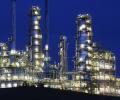
BPCL's impending privatisation and RIL's stake sale to Saudi Aramco raise questions about the future of the West Coast Refinery, once touted as the world's largest.
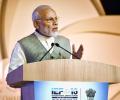
The world, he said, needs to move towards a transparent and flexible market for both oil and gas.

The revised projection comes after a 17% rise in the April-June.
